Real-Time Data for AI: Streaming Architecture That Actually Works in 2026
Batch processing won the last decade. It was predictable, correct, and easy to reason about. But AI in 2026 does not wait for the next ETL run. Fraud detection, real-time personalization, predictive maintenance, and agentic systems all require decisions made while the data is still warm—sometimes within milliseconds. Streaming is no longer a niche concern for hedge funds and ad-tech. It is strategic infrastructure.
The good news: the tooling has matured. What used to require bespoke distributed systems is now accessible through well-documented platforms with managed offerings, clear APIs, and strong community ecosystems. The bad news: streaming is still harder than batch. It demands new mental models for state, time, failure, and cost.
This article covers the architecture patterns, technologies, and operational practices that make real-time data pipelines actually work for machine learning in 2026.
The Streaming Backbone: Kafka, Pulsar, and Redpanda
At the heart of any streaming architecture is the event log: an immutable, ordered, replayable stream of events that acts as the single source of truth for real-time data.
Apache Kafka remains the de facto standard. With over 150,000 organizations running it in production, Kafka has evolved from a scalable messaging layer into a central nervous system for digital business. Kafka 3.8+ runs in KRaft mode (ZooKeeper-free), supports tiered storage for cost-efficient long-term retention, and provides exactly-once semantics through idempotent producers and transactional APIs.
Apache Pulsar offers multi-tenant messaging with geo-replication and tiered storage natively. It separates compute and storage more cleanly than Kafka, which can simplify operations at massive scale. However, ecosystem maturity and tooling density still lag behind Kafka, and some analysts project Pulsar may fade from the landscape as Kafka-compatible platforms consolidate market share.
Redpanda is a C++ reimplementation of the Kafka protocol, designed for simplicity and performance. It runs as a single binary without a ZooKeeper or KRaft dependency, starts in seconds, and delivers lower p99 latencies in many benchmarks. For teams that need Kafka compatibility without JVM operational complexity, Redpanda is increasingly the pragmatic choice.
Key design decisions for your event backbone:
- Partition count should be driven by throughput targets (~10 MB/s per partition is a reasonable heuristic).
- Replication factor of 3 with
min.insync.replicas=2 provides durability without excessive write latency.
- Schema-first design using Confluent Schema Registry or equivalent ensures contracts between producers and consumers. Never change field types; only add optional fields.
- Naming conventions like
{domain}.{entity}.{version} (trading.orders.v2) prevent topic sprawl.
Stream Processing: Flink, Spark Structured Streaming, and ksqlDB
Events sitting in a log are inert. Stream processors bring them to life.
Apache Flink is the current gold standard for stateful stream processing. Flink 2.0 unified batch and streaming APIs, meaning the same code handles historical backfills and live processing. It provides sub-second latency, event-time semantics, and exactly-once state checkpoints. Flink’s RocksDB state backend can manage terabytes of state, and incremental checkpointing keeps recovery times manageable.
For ML use cases, Flink excels at:
- Real-time aggregations and windowed statistics for feature computation
- Complex Event Processing (CEP) for fraud pattern detection
- Stream enrichment and joining multiple event sources
- Filling feature stores with fresh, computed features
Spark Structured Streaming remains the top choice for teams already invested in the Spark ecosystem. It offers SQL, Python, Scala, and Java APIs; deep integration with Delta Lake; and mature monitoring dashboards. Spark is micro-batch under the hood, which adds latency (typically seconds, not milliseconds) but simplifies operations and integrates cleanly with batch workflows.
ksqlDB provides a SQL interface over Kafka Streams for simpler transformations, filtering, and materialized views. It lowers the barrier to entry for teams without dedicated stream-processing engineers. However, ksqlDB is best for lightweight use cases. Complex stateful logic, large-scale joins, and custom ML feature computation still belong in Flink or Spark.
Lambda vs. Kappa: Choosing Your Architecture
Lambda Architecture maintains two parallel pipelines: a batch layer for correctness and historical completeness, and a speed layer for low-latency insights. The serving layer merges both. Lambda is robust but operationally expensive—you maintain two codebases, two teams, and two failure modes.
Kappa Architecture eliminates the batch layer entirely. All data is treated as a stream. Historical reprocessing is achieved by replaying archived events through the same stream processor. This simplifies operations, unifies business logic in one place, and reduces the surface area for bugs.
In 2026, Kappa is the preferred default for new systems. Batch is simply a special case of streaming: a bounded stream with a start and an end. Flink 2.0 and Spark Structured Streaming both support this unified model. Choose Lambda only when you have genuinely divergent latency and correctness requirements that cannot be served by a single engine, or when legacy batch infrastructure cannot be retired.
Real-Time Feature Pipelines
The gap between raw events and model-ready features is where most streaming ML projects stall. A feature store bridges this gap by providing:
- Offline storage for point-in-time-correct training datasets
- Online storage for low-latency feature serving at inference time
- A registry that defines features once and uses them consistently across training and production
Feast (open-source) ingests precomputed features from batch pipelines or streaming sources (Kafka via Spark Streaming) and serves them through a unified API. It decouples ML teams from underlying data infrastructure. Redis or DynamoDB typically back the online store, with gRPC serving for lowest latency.
Tecton (managed) goes further by internalizing feature pipelines. Data scientists define transformations in Python or SQL; Tecton materializes batch, streaming, and real-time features automatically. It also includes built-in monitoring for feature freshness, null rates, and data drift.
For real-time AI, feature freshness is the critical metric. Measure it end-to-end: change a source value, then time how long until the served feature reflects it. Sub-second is achievable with Flink feeding Redis; minutes is typical for batch-sync architectures.
Online Inference with Streaming Data
Online inference means scoring a model while the user is still on the page, the transaction is still in flight, or the sensor is still emitting. Latency budgets are tight:
- Fraud detection: < 100ms end-to-end
- Real-time recommendations: < 50ms
- High-frequency trading: < 10ms
Architecture pattern:
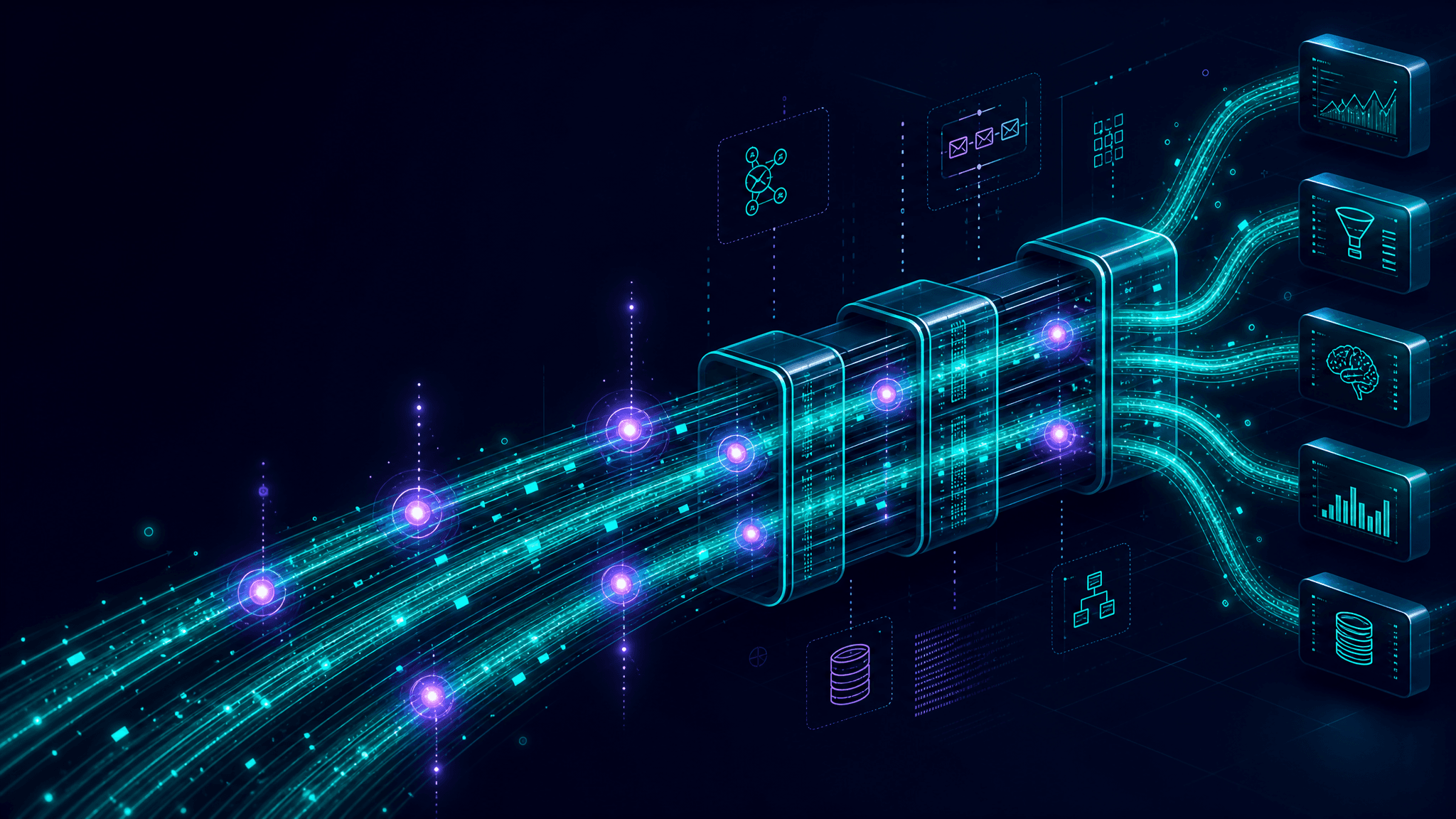
- Events (clicks, transactions, sensor readings) flow into Kafka/Redpanda.
- Flink computes features in real time: rolling averages, session lengths, behavioral embeddings.
- Features land in a low-latency online store (Redis, DynamoDB, or Tecton’s managed store).
- The inference service fetches features by entity key and calls the model (often hosted via Triton, Seldon, or a custom gRPC service).
- The prediction routes back to the application or triggers an action.
Model serving and feature serving must be co-optimized. If p99 feature retrieval latency is 30ms and model inference is 20ms, you have 50ms before the user notices. Every millisecond counts.
Exactly-Once Semantics and Backpressure
Exactly-once processing means every event is processed precisely one time, even through failures, restarts, and rebalances. This is essential for financial transactions, inventory management, and ML feature accuracy.
Kafka provides exactly-once through idempotent producers and transactional writes. Flink provides exactly-once through distributed snapshots (checkpoints) that capture operator state consistently. In practice, exactly-once adds operational overhead: longer checkpoint intervals increase replay volume; shorter intervals increase I/O load. A 1–5 minute checkpoint interval is a common production default.
Backpressure occurs when downstream consumers cannot keep pace with upstream producers. Without handling, this leads to memory exhaustion, dropped messages, or cascading failures. Flink handles backpressure naturally by propagating pressure upstream—slow sinks slow the entire topology. Kafka consumers can be tuned with max.poll.records and dynamic fetch sizes. Monitor consumer lag relentlessly; it is the single most important streaming health metric.
Observability in Streaming Systems
You cannot debug a distributed stream by tailing a log file. Observability must be designed in from the start.
Critical metrics:
- Consumer lag: How far behind real-time is each consumer group?
- Checkpoint duration and failures: Are Flink snapshots completing on time?
- Throughput and latency: Events per second, p50/p99 end-to-end latency.
- Feature freshness: Time from event to served feature.
- Null rates and data drift: Are features degrading silently?
Tools: Prometheus + Grafana for infrastructure metrics; Confluent Control Center or Redpanda Console for Kafka-specific visibility; Flink’s Web UI for job-level diagnostics; and OpenTelemetry for distributed tracing across the inference pipeline.
Cost Optimization
Streaming can be expensive if left unmanaged. Key strategies in 2026:
- Tiered storage: Kafka’s tiered storage offloads older segments to S3 automatically, reducing broker disk costs by 60–80% for long-retention topics.
- Diskless Kafka: Emerging architectures store all data in cloud object storage with brokers acting as pure compute layers. This enables elastic scaling and near-zero idle cost.
- Right-size partitions: Over-partitioning increases coordination overhead; under-partitioning limits parallelism.
- Managed services: Confluent Cloud, Redpanda Cloud, and Ververica Platform reduce operational headcount at the cost of per-unit pricing. Run the math for your scale.
- Replay discipline: Kappa’s replay capability is powerful but can spike compute costs. Archive older streams to Iceberg or Delta Lake for historical access without replaying through the live cluster.
Case Studies
Fraud Detection (< 100ms): A global payments platform ingests transaction events into Kafka, enriches them with Flink CEP for pattern matching, computes rolling risk features, and serves them to an XGBoost model via Redis-backed Feast. Suspicious transactions are declined before authorization completes.
Real-Time Personalization: An e-commerce platform captures clickstreams into Redpanda, computes session-level features in Flink (dwell time, category affinity, cart abandonment signals), and serves them to a two-tower neural network. Product rankings update within 200ms of a user action.
IoT Predictive Maintenance: Thousands of industrial sensors emit telemetry via MQTT into Kafka. Flink rolling statistics detect anomaly patterns, trigger alerts, and update predictive models. Maintenance crews receive notifications before equipment fails.
Key Takeaways
- Streaming is strategic infrastructure for AI in 2026, not a bolt-on optimization.
- Kafka + Flink is the de facto standard, but Redpanda and Spark Structured Streaming are valid alternatives depending on team skills and latency requirements.
- Kappa Architecture should be the default; treat batch as a bounded stream.
- Feature stores (Feast, Tecton) close the gap between raw events and model-ready vectors. Freshness is the metric that matters.
- Exactly-once and backpressure handling are non-negotiable for production. They require tuning and monitoring, not just checkbox configuration.
- Observability must be built in, not added later. Consumer lag, checkpoint health, and feature freshness are your vital signs.
- Cost optimization comes from tiered storage, right-sized partitions, and disciplined replay—not from skipping redundancy.
Real-time data for AI is no longer science fiction. The tools exist, the patterns are proven, and the failures are well-documented. The teams that succeed are the ones that treat streaming as a first-class discipline—designing for failure, measuring obsessively, and optimizing for both latency and correctness from day one.
 data-engineering